Demonstration models
Model configurations
The three models share two message-passing layers, separate-weight tensor products, the rich edge encoder with harmonic tensor square, invariant attention aggregation, split per-pair heads with separate shifted-self handling and no spectral loss. They differ in:
Setting |
ZnCu2Sn(SeS)2 |
SiO2 |
Perturbed Si |
|---|---|---|---|
Targets |
H |
H |
H, D, S |
Cutoff / \(\ell_{\max}\) |
11 Å / 6 |
10 Å / 4 |
8 Å / 4 |
Neck / head depth |
2 / 1 |
1 / 1 |
2 / 2 |
Head block |
NormAct |
NormAct |
FiLM |
Distance envelope |
multiply prediction |
multiply prediction |
off |
Band-energy guidance |
off |
off |
\(3\times10^{-3}\), reference partner |
Split (train/val), seed |
80/20, 44 |
90/10, 42 |
80/16, 43 |
The complete configurations of the evaluated checkpoints are in
paper/data/evaluated_model_configs/{zncu2sn_ses2,sio2,silicon_perturbed}.yaml.
The paper appendix lists their hidden irreps; e.g. the SiO2 model
uses
128x0e+64x0o+32x1e+32x1o+24x2e+24x2o+16x3e+16x3o+8x4e.
Training recipes
scripts/reproduce_examples contains one frozen recipe per material
(zncusnses.json, sio2.json, silicon.json) with the architecture,
objective, optimizer, scheduler, spike-rollback settings, split sizes and
seeds of the selected models, the fitted distance envelopes
(*_envelope.json, verified by SHA-256 at start-up) and one launcher per
material. Each recipe initializes all weights from scratch.
These are fresh training experiments with the selected architectures and
objectives, not a replay of the historical fine-tuning and restart sequence.
The source learning rates and checkpoint ancestry are documented in
scripts/reproduce_examples/README.md. In particular, silicon uses the
current native spin=0 density convention, whereas the historical targets were
doubled; its density and energy errors cannot be compared directly with the
historical values below.
Recipe |
Targets / loss |
Initial LR |
Seeds (train / split) |
Epoch cap |
|---|---|---|---|---|
|
H / MSE |
0.0108 |
44 / 44 |
3000 |
|
H / MAE |
0.0027 |
42 / 42 |
4000 |
|
H, D, S / MAE + band energy (\(3\times10^{-3}\)) |
0.001 |
43 / 43 |
5000 |
Point the recipe to your data. Edit the
trainingblock of the recipe —data_path,checkpoint_dir— andsave_dirandsnapshot_cache_dirinconfig:The hard-coded
/bigdata/...locations are the authors’ HPC paths; replace them with your local paths for the deposited datasets and training outputs (a RODARE data deposit is being prepared)."training": { "dataset_kind": "silicon_scales", "data_path": "/data/perturbed_Si", "checkpoint_dir": "/runs/publication", "scales": [1], "num_train_per_scale": 80, "num_val_per_scale": 16 }
Inspect the resolved plan (no files are written, no GPU is used):
bash scripts/reproduce_examples/train_silicon.sh --plan
Train. Run each launcher in its own single-GPU allocation:
bash scripts/reproduce_examples/train_zncusnses.sh
bash scripts/reproduce_examples/train_sio2.sh
bash scripts/reproduce_examples/train_silicon.sh
A segment budgets 45 hours and stops at an epoch boundary; request 48 hours to leave room for the final epoch and checkpoint I/O. The final complete epoch can overrun the budget. Re-running the same command continues the run from
<checkpoint_dir>/<run>/latest_checkpoint.ptwith the full optimizer, scheduler, RNG and model-selection state, until the cumulative epoch cap is reached.--action startrefuses to touch an existing run;--action continuerequires one.Every run writes a contract (
<run>.contract.json) with the SHA-256 of the recipe and of every source file, the installed package versions, the GPU and the determinism settings. Continuation with a different recipe, code or runtime is refused. Input manifests also reject changed split identities, sizes or modification times. Preserve the immutable data: large inputs are not content-hashed, and CUDA scatter reductions can still be nondeterministic.
Validation metrics
Compute the absolute and relative validation errors of a newly trained
checkpoint with the deterministic validation split of its recipe. Run all
commands from the repository root. The /runs/... and /data/... paths
below are examples to replace with your checkpoint and dataset paths:
PYTHONPATH=src:. python scripts/report/evaluate_validation_relative_metrics.py \
  --checkpoint /runs/publication/silicon/best_model.pt \
  --dataset-kind silicon_scales --data-path /data/perturbed_Si \
  --scales '[1]' --num-train-per-scale 80 --num-val-per-scale 16 \
  --data-split-seed 43 --output-json silicon_metrics.json
For SiO2, change --dataset-kind to siox, select its checkpoint
and data root, and replace the silicon split options with
--num-train 90 --num-val 10 --data-split-seed 42. For ZnCu2Sn(SeS)2,
use --dataset-kind ZnCuSnSeS, its checkpoint and data root, and
--scales '[1]' --num-train-per-scale 80 --num-val-per-scale 20 --data-split-seed 44.
The relative error divides the mean per-structure
validation MAE by the mean absolute reference value over the same validation
structures. Exact historical split membership is not asserted by the fresh
recipes. The values of the published checkpoints are stored in
paper/data/validation_relative_metrics:
Material |
Metric |
Value (relative) |
|---|---|---|
ZnCu2Sn(SeS)2 |
Hamiltonian MAE |
3.012 meV (2.95 %) |
SiO2 |
Hamiltonian MAE |
1.996 meV (1.67 %) |
SiO2 |
Band-energy MAE, \(\Tr(D^{\text{ref}}H^{\text{pred}})\) |
0.146 eV/atom (0.193 %) |
Silicon |
Hamiltonian MAE |
0.4352 meV (0.355 %) |
Silicon |
Density-matrix MAE |
\(5.758\times10^{-5}\) (1.95 %) |
Silicon |
Overlap MAE |
\(1.390\times10^{-5}\) (0.109 %) |
Silicon |
Band-energy MAE |
0.0207 eV/atom (0.0631 %) |
Hamiltonian errors are shift-resolved block errors after Hermitian projection, in eV; density and overlap errors are dimensionless.
Figures
scripts/evaluate_checkpoint_materials.py produces the per-structure
figures — block heat maps of the first atoms, element correlation, relative
block error versus distance, density of states and band structure — for a
checkpoint and one validation structure:
PYTHONPATH=src:. python scripts/evaluate_checkpoint_materials.py \
  --checkpoint /runs/publication/silicon/best_model.pt \
  --mode snapshot --snapshot-path /data/perturbed_Si/scale_1/Si_scale_1_090 \
  --output-dir figures/silicon \
  --path-string LGXUG --dos-kmesh 4x4x4 --use-gt-overlap-for-eigs --max-atoms 8 \
  --hamiltonian-clim 0.01 --density-clim 0.01
The paper uses validation structure no. 94 for ZnCu2Sn(SeS)2,
13_67164000 for SiO2 (DOS with \(\sigma=0.2\) eV on a
\(2\times2\times2\) mesh) and no. 90 for silicon (path
\(L\to\Gamma\to X\to U\to\Gamma\), tetrahedron DOS on \(4\times4\times4\)).
Run the script with --help for all plotting options (colour limits,
energy windows, DOS method, k-meshes).
The silicon band-structure and DOS figure is generated by the command above; the rendered figure is not bundled in this checkout.
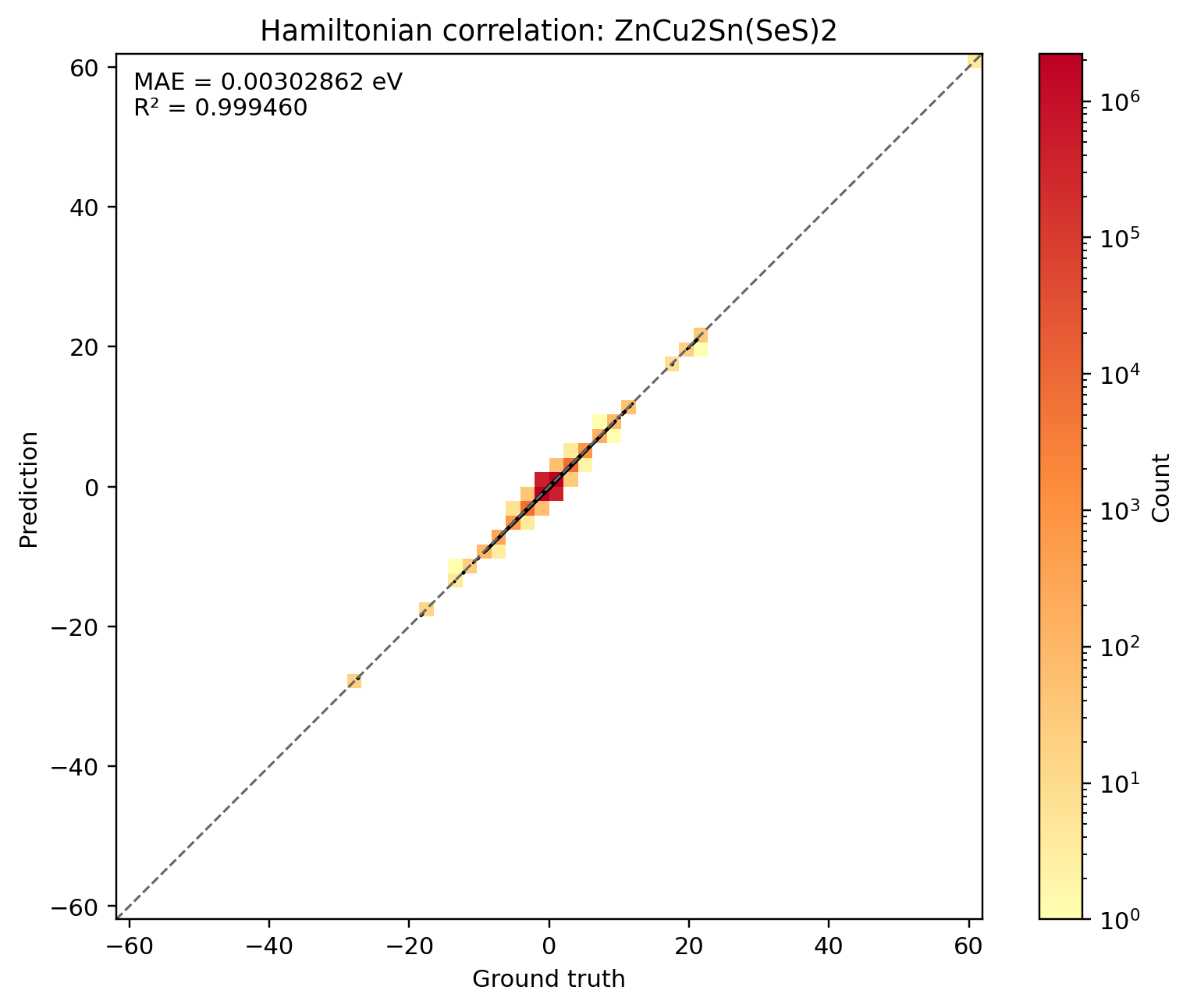
Correlation of all 5 345 640 Hamiltonian elements of the representative ZnCu2Sn(SeS)2 validation structure (MAE 3.029 meV, \(R^2=0.999460\)).
Paper figures and tables
The manuscript sources are not part of this repository. The data behind the
paper’s figures and tables are in paper/data and the figures are
regenerated with
python paper/generate_result_plots.py
which writes to paper/figures.