Ablations and scaling
Protocol
Every ablation compares two or three settings of one configuration field
across matched seeds, with all other settings, the dataset membership
(data-split-seed 42) and the 12-hour wall-clock budget held fixed. The
sweeps are W&B grid sweeps over (setting, seed) executed by
scripts/wandb_run.py; ablation-setting-from names the varied field so
that every run is labelled <ablation>_<setting>_seed<seed>. Each run ends
with one held-out test evaluation.
Ablation |
Varied field and settings |
Sweep files ( |
|---|---|---|
SiO2 energy guidance |
|
|
ZnCu2Sn(SeS)2 spectral guidance |
|
|
ZnCu2Sn(SeS)2 distance envelope |
|
|
Silicon node aggregation |
|
|
The energy- and spectral-guidance studies (“mature”) fine-tune the selected
demonstration models with each setting (resume-from-checkpoint,
compatibility: true), measuring the effect of the objective on an
already accurate network. The envelope and aggregation studies train from
scratch.
Running a sweep
Edit the dataset, cache and checkpoint paths (
data-path,snapshot-cache-dir,checkpoint-dirand, for mature studies,resume-from-checkpoint) in the sweep file, or regenerate all sweep files from the shared matrix after editing it:python sweeps/paper_ablations/generate_sweeps.pyRegister the sweep and start agents until its
run_capis reached:wandb sweep sweeps/paper_ablations/paper_silicon_node_aggregation_12h.yaml wandb agent <entity>/<project>/<sweep-id>
Check the paired design (every seed present for every setting):
PYTHONPATH=src:. python scripts/report/aggregate_paper_ablation.py \
  --entity <entity> --project paper_silicon_node_aggregation_12h \
  --group paper_silicon_node_aggregation_12h --baseline average \
  --expected-seeds 5 --output silicon_node_aggregation.json
Export the run summaries and draw the figures:
python paper/download_ablation_csvs.py
python paper/generate_result_plots.py
paper/data/*.csv contains the summaries of the published runs (seed,
setting, Hamiltonian MAE, observable MAE, split), so step 4 reproduces the
published figures directly from them.
Results
Ablation |
Effect (medians over matched seeds) |
|---|---|
Energy guidance, SiO2 (test) |
\(10^{-4}\): band-energy MAE 0.245 → 0.078 eV/atom (−68 %), Hamiltonian MAE +4.7 %; \(10^{-3}\) is worse than \(10^{-4}\) on both. |
Spectral guidance, ZnCu2Sn(SeS)2 (test, 10 seeds) |
Eigenvalue MAE 0.579 → 0.0391 eV, paired mean improvement 92.1 %, all seeds improve; Hamiltonian MAE unchanged within its confidence interval. |
Distance envelope, ZnCu2Sn(SeS)2 (test) |
Hamiltonian MAE −3.8 %, four of five seeds improve. |
Attention vs. average, silicon (validation) |
Hamiltonian MAE −10.1 %. |
The spectral- and energy-guidance figures are generated by step 4 above. Their rendered PNG files are not bundled in this checkout.
Inference scaling
Target-free inference on diamond-silicon supercells of 8 to 4096 atoms with the silicon model:
PYTHONPATH=src:. python scripts/generate_silicon_scaling_cifs.py --output-dir cifs/
PYTHONPATH=src:. python scripts/benchmark_silicon_cif_scaling.py \
  --checkpoint /runs/publication/silicon/best_model.pt \
  --structures-dir cifs/ --output scaling.txt --device cuda \
  --warmup-runs 2 --atom-counts 8,64,512,4096
PYTHONPATH=src:. python scripts/plot_silicon_cif_scaling.py \
  --input scaling.txt --output-dir figures/
Replace the checkpoint path with your trained silicon model. The CIFs and
text timing log are generated by the preceding commands; the benchmark writes
a text log, not JSON. --atom-counts selects the published range explicitly
(the benchmark’s default also includes 32768 atoms).
The benchmark separately times graph construction, the forward pass and block reconstruction (two warm-up calls, ten timed repetitions) and records the peak memory of each phase. On one NVIDIA B200 GPU the total time grows from 0.364 s (8 atoms) to 97.0 s (4096 atoms; 1 216 512 blocks), with the forward pass taking 3.17 s of that at the largest size.
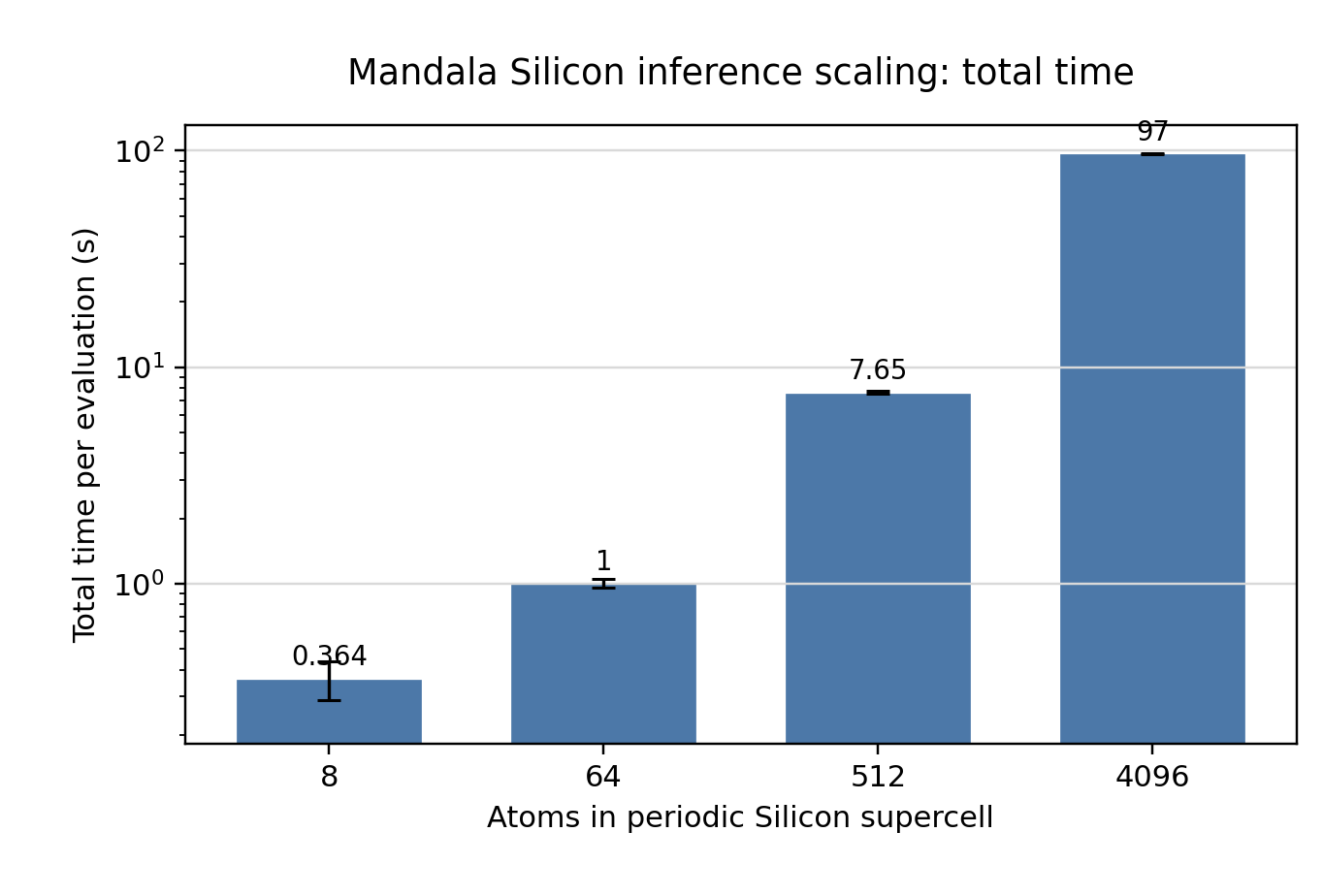
Total inference wall time versus number of atoms.